- Civil
- Insight
- Construction excellence
Oct 6, 2026
The construction industry has spent the past decade moving toward more collaborative ways of delivering complex projects. Faced with greater technical complexity, more stakeholders, tighter schedules, and increased public scrutiny, owners have increasingly adopted delivery approaches that bring project partners together earlier and support more integrated decision-making.
The value of early engagement is no longer up for debate. The challenge now is ensuring collaboration continues long after procurement is complete. Collaboration isn’t something established through a contract alone. It’s a behaviour that must be sustained through leadership, trust, and a shared commitment to project success.
At EllisDon, we’ve seen firsthand how early contractor involvement changes project outcomes. Bringing construction expertise into planning and design allows teams to address constructability, staging, utility coordination, and risk before these issues disrupt delivery.
These approaches create a framework for better outcomes, but they don’t automatically create the behaviours that make collaboration work. Projects still struggle when information is withheld, difficult conversations are delayed, or project partners focus more on protecting their positions rather than solving the problem. Even within modern delivery models, the industry can default to familiar behaviours.
Changing a contract is relatively easy. Changing behaviours and governance is much harder.
In many ways, the industry is still navigating the shift from a mindset focused on risk transfer to one focused on managing it collectively.
In my view, that’s where the next evolution of infrastructure delivery begins.
The most effective project environments are those in which stakeholders work together to identify, understand, and address risks collectively rather than focusing primarily on where responsibility ultimately resides.
Project success has traditionally been measured by whether it was delivered on time and on budget. These metrics remain critically important, but they are no longer sufficient. Today’s owners also expect transparency, stakeholder alignment, and minimized community impact. They want confidence that risks are being actively managed, information is shared openly, and teams remain aligned when challenges emerge.
In other words, success today isn’t measured only by what gets delivered, but also by how risks are managed, how decisions are made, and how teams respond when challenges arise. Those moments reveal whether collaboration was truly embedded in delivery or simply referenced in a contract.
What changes most in an integrated project environment is the speed and quality of decision-making. When owners, designers, and builders are working from the same information and aligned on objectives, risks surface earlier, options are evaluated more effectively, and decisions are made with a clearer understanding of their impact. Teams spend less time determining who owns the problem and more time determining how to solve it.
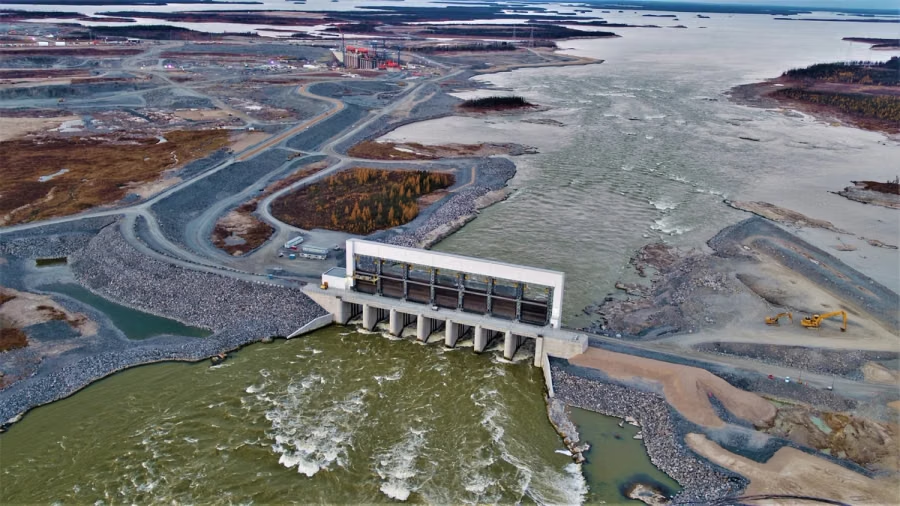
One project that exemplifies this is Toronto’s Port Lands Flood Protection project.
Delivering one of North America’s most ambitious urban redevelopments which included building a new river through the heart of Toronto was no small feat.It required an extraordinary level of integration between owners, designers, constructors, and numerous stakeholders throughout planning and execution. The result set a precedent for what it takes to deliver a mega project.
We’ve seen similar lessons emerge on major transit programs such as the Lakeshore West Corridor Expansion, where work must be delivered within an active rail corridor while maintaining ongoing operations.
While the challenges facing a live transit corridor are very different from a flood protection program, both projects reinforce the same lesson: success depends not only on the delivery model, but the quality of the relationships, transparency, and decision-making within it.
As infrastructure projects continue to grow in scale and complexity, owners are increasingly looking for partners who can support project development, navigate challenges with confidence, provide informed solutions, and above all, foster relationships that make everything else possible.
In today’s construction environment, certainty has become just as valuable as capability.This is where experience matters.
At EllisDon, we’ve never viewed our role as simply builders. As collaborative delivery models have evolved, we’re focused on helping clients realize the value these approaches bring through experience, expertise, partnership mindset, and a fast, fluid, and flexible approach.
While technology will continue to evolve, and specialized expertise will continue to deepen, I do believe the next major shift will be cultural. Organizations that foster trust, accountability, and alignment across the project team will be best positioned to deliver increasingly complex and critical infrastructure with confidence.
Ultimately, better project outcomes don’t come from contractual commitments to collaborate.
They come from the people and teams who put it into practice.
Latest Insights
Oct 6, 2026
Oct 1, 2026
Sep 16, 2026
Aug 19, 2026
Jul 14, 2026
Whether you’re exploring partnership or seeking guidance on a development, we’re ready to help you move forward with confidence.
Contact Us